A NEW SIGNAL FROM THE UNKNOWN

Space
BunnyALPHA

Big context. Curious mind.

An anonymous reasoning model with a million-token context, image and video input, and a free preview. Let’s see what this bunny can do.

Independent field guide · Checked

SPECIMEN 001 / ORIGIN UNKNOWN
A determined astronaut bunny reaches for a floating carrot while a smaller bunny peeks around their lavender moon.
1M tokensContext window
524K tokensCompletion ceiling · 524,288
Text. Image. Video.Three input types → text output
$0 / 1M tokensInput & output · free preview

DEMODOKOS / LOCAL AI AUDIO

Little scene.
Big atmosphere.

Expressive voices. Original music.
Produced on your own PC.

Meet the studio

A little ear candy.

Scene 01 · Demodokos demo

01 SPECS, SPEED & RESEARCH

What the numbers
mean for you.

Room for long documents. Speed for everyday work. Clues to the model’s origins. Explore twelve findings and the evidence behind them.

Provider specifications & telemetryIndependent testsIdentity hypothesis

Tokens are pieces of text. Context is what fits in a request. P50 means the median.

Provider-listed
1,000,000
tokens of context

Room for big inputs

Bring a long brief, substantial documents or a sizeable codebase into one request.

OpenRouter ·

Details & sources

Provider-listed context capacity for stealth/space-bunny-alpha. Context capacity and completion budget are separate limits.

OpenRouter model listing OpenRouter models catalog
Provider-listed
524,288
completion-token ceiling

Space for long answers

A large output budget for long explanations and code. Reasoning uses part of that budget.

OpenRouter ·

Details & sources

Provider-configured maximum completion tokens. This is a budget ceiling, not a measured answer length; reasoning and visible output share the completion budget.

OpenRouter models catalog OpenRouter reasoning tokens
Provider-listed
87
tokens / second · P50

How fast it writes

The median speed at which the model generates tokens. Higher throughput means less waiting for a long response to finish.

OpenRouter ·

Details & sources

OpenRouter P50 throughput, best across providers. Dashboard filters: all reasoning efforts and all locations. Snapshot around 00:28 UTC on 24 September 2026.

OpenRouter model listing
Provider-listed
1.07 s
OpenRouter P50 latency

How quickly it responds

OpenRouter’s median response delay: just over a second in this snapshot.

OpenRouter ·

Details & sources

OpenRouter P50 latency, best provider. Filters: all reasoning efforts and all locations. Snapshot around 00:28 UTC on 24 September 2026.

OpenRouter model listing
Provider-listed
94.98%
inference availability · 3-day view

Requests that got a response

At least one provider returned a response for this share of requests. Errors and empty responses count against the score.

OpenRouter ·

Details & sources

OpenRouter’s 3-day dashboard measures whether inference returned from at least one provider. Reachability is separate at 97.70%; 24-hour inference availability is 95.60%. Snapshot around 00:28 UTC on 24 September 2026; model listed 23 September.

OpenRouter model listing
Independent test
24/24
token-count probes matched

MiniMax tokenizer match

The way it counts pieces of text matched MiniMax on every test—a strong clue to the model family.

OpenCode Go ·

Details & sources

Published delta vectors match both named MiniMax endpoints on all 24 probes. L1 output cap: 1 token; local reference: MiniMax M1 tokenizer. This fingerprint does not establish ownership or an exact checkpoint.

stealthprint case study stealthprint measurement data
Independent test
+143
typical extra prompt tokens

Tokens beyond your prompt

The service usually counted 143 input tokens beyond the supplied text. This repeatable overhead helps fingerprint the route.

OpenCode Go ·

Details & sources

Reported prompt tokens minus the local MiniMax count of user content: +143 from the base test through the 1M-token ladder. A separate 810K retrieval probe recorded +157. This measures route-level token accounting.

stealthprint case study stealthprint measurement data
Independent test
3/3
codes recovered · one 200K-token run

Finds details in a long input

Found three different codes hidden in a very long input, and returned them in the correct order.

OpenCode Go ·

Details & sources

All three distinct codes were returned in order in one trial containing 200,044 local tokens and 200,187 reported prompt tokens.

stealthprint case study stealthprint measurement data
Independent test
14/14
requests returned successfully

Consistent across repeated calls

Seven text and seven image requests all succeeded, with consistent response formats and token counts within each group.

OpenCode Go ·

Details & sources

Seven text requests at temperature 2.0 and seven repeated 64 × 64 red-image requests. All returned HTTP 200. Prompt counts were 146 for text and 195 for images; message fields were consistent. This does not establish identical backend weights.

stealthprint case study stealthprint measurement data
Independent test
8/8
64 × 64 color images identified

Recognizes colors in images

Correctly identified four red and four blue images. A simple demonstration that the endpoint handles image input.

OpenCode Go ·

Details & sources

Four solid-red and four solid-blue images, each 64 × 64 pixels, were identified correctly. A separate 1 × 1 red-image check returned three correct answers from four attempts.

stealthprint case study stealthprint measurement data
Independent test
Nov 2025
late-2025 event recalled

A dated knowledge check

Correctly named the release month of Claude Opus 4.5—a concrete example of late-2025 information it recalled.

OpenCode Go ·

Details & sources

Space Bunny correctly named November 2025 as the release month of Claude Opus 4.5. Anthropic’s announcement dates the launch to 24 November. This checks recall of one dated event.

stealthprint measurement data Anthropic: Introducing Claude Opus 4.5
Hypothesis
MiniMax M3.1?
exact model unconfirmed

Who might be behind it?

The tokenizer tests make MiniMax the family-level lead. M3.1 is a proposed identity; the developer and exact version remain unconfirmed.

Identity hypothesis ·

Details & sources

The study compares MiniMax M3 and M2.5 and finds a shared tokenizer signature. M3.1 is a proposed exact-version hypothesis, not a finding of that test. The developer has not revealed the model’s identity.

stealthprint case study stealthprint measurement data

Independent probes: stealthprint on OpenCode Go’s space-bunny-free, reported 24 Sep. Provider figures: OpenRouter.

Compare OpenCode’s measured speed TokenDyno · archived 24 Sep 2026 snapshot

Streaming speed

TOKENS / SECOND
OpenCode GoTokenDyno · 24h average
94.3
OpenCode ZenTokenDyno · 24h average
84.9

Same HTTP-routing writing task, 300-token output cap. Latest rates: Go 89.9 tok/s; Zen 74.5 tok/s. Method ↗

FIRST VISIBLE TEXT

1.2sOpenCode Go
latest test

1.6sOpenCode Zen
latest test

Successful tests / 24hGo 7 / 7 · Zen 4 / 4
Earlier route-specific measurements · 24 Sep 2026Go results ↗Zen results ↗

03 THE MYSTERY

Who’s inside
the helmet?

The developer is still anonymous. One tokenizer clue points toward a familiar family.

IDENTITY STATUSUnconfirmed.Curiosity: fully operational.
Provider-listed

A new arrival on OpenRouter

Space Bunny Alpha is listed as a reasoning model from an anonymous third-party provider. OpenRouter is the gateway.

Read the listing ↗
Hypothesis

A MiniMax-compatible signature

stealthprint reports 24 / 24 matching token-count probes on OpenCode Go, including comparisons with that gateway’s MiniMax M3 and M2.5.

A tokenizer-family clue. Shared tokenizers and gateway accounting can match without proving the developer or exact checkpoint.

Inspect the measurements ↗

04 PUT IT TO WORK

More than
a chat box.

Use the model’s inputs, tools and reasoning controls to shape your next task.

Build your first request ↓

Ask about what you can see.

Send a screenshot, diagram or video alongside your question. Space Bunny accepts text, images and video, and replies in text.

Connect it to your tools.

Your application can offer functions, such as finding a file or looking up a record. The model can request the right function and supply its arguments.

Choose the reasoning effort.

OpenRouter offers low, medium, high, xhigh and max. Reasoning stays on; our code builder starts at low, while the provider currently defaults to max.

API format and model details

JSON response format is supported, without JSON Schema enforcement. The neural architecture, parameter count and training details remain undisclosed. Provider catalog ↗

DEMODOKOS FOUNDRY / MUSIC · VOICE · VIDEO

YOUR IDEAS. A WHOLE NEW SOUND.

Made on Earth.
Sounds out of this world.

Turn dialogue into a performance. Add original music, expressive voices, translation and subtitles — all in one local studio.

Scene 02 · Demodokos demo

Create with Demodokos Windows · Your GPU
CREATIVE MISSION CONTROL
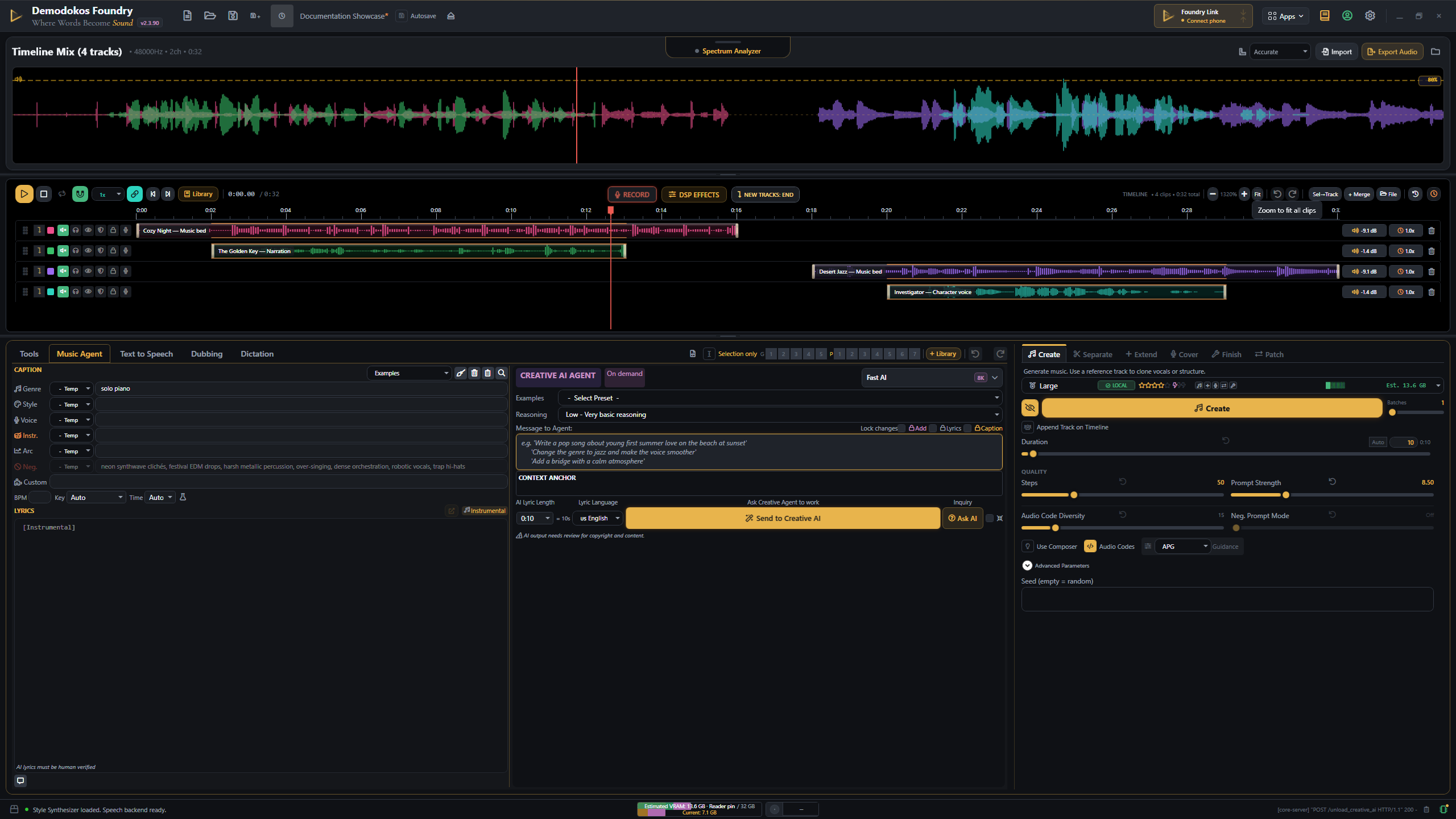
Demodokos production workspace with dialogue, music and audio waveforms.
Music. Voices. Subtitles. One workspace.

05 THE LAUNCHPAD

Ready for
first contact?

Choose a route, shape a request and take the code with you. Your next experiment starts here.

OpenRouter

Free preview
stealth/space-bunny-alpha

Prompts and completions may be retained by the provider; they are not used for training.

Open the model ↗

OpenCode Zen

Limited-time preview
space-bunny-free

Model-specific documentation states zero retention and no training use. Account and route eligibility apply.

OpenCode setup ↗
REQUEST BUILDER

The example requests 4,096 output tokens. OpenRouter’s reasoning uses part of that budget.

Reasoning controls ↗
curl https://openrouter.ai/api/v1/chat/completions \
  -H "Authorization: Bearer $OPENROUTER_API_KEY" \
  -H "Content-Type: application/json" \
  -d '{
    "model": "stealth/space-bunny-alpha",
    "messages": [{"role": "user", "content": "Write a Python function that validates SRT timestamp order. Include three unit tests."}],
    "reasoning": {"effort": "low"},
    "max_tokens": 4096
  }'
Run locally with your own environment key.

Preview pricing checked 24 Sep 2026. Account limits and rate limits apply. OpenRouter limits ↗

06 BEFORE YOU HOP

A few good
questions.

What is Space Bunny Alpha?

A reasoning model from an anonymous provider, listed on OpenRouter on 23 September 2026. It accepts text, images and video and returns text, including code and tool requests. OpenCode lists Space Bunny Free under its own API model ID.

Is Space Bunny Alpha good?

Yes, especially for creative SVG work. Space Bunny Alpha’s SVG benchmark showcases a rare artistic touch, with expressive characters, thoughtful composition and a distinctive sense of color.

Is Space Bunny Alpha a MiniMax model?

The developer is unconfirmed. An independent OpenCode Go study found a MiniMax-compatible token-count signature on 24 probes. That is a family-level clue. MiniMax M3.1 is a proposed candidate, but the exact model has not been revealed.

Is Space Bunny Alpha free?

OpenRouter currently lists $0 input and $0 output per million tokens for the preview. OpenCode describes its offer as free for a limited time. Account eligibility and rate limits still apply.

What is Space Bunny Alpha’s context window?

OpenRouter lists 1,000,000 context tokens and a separate maximum-completion ceiling of 524,288 tokens. Reasoning contributes to completion-token accounting. The context listing and output ceiling are capacities, not measured retrieval or generation scores.

Where can I use Space Bunny Alpha?

Use Space Bunny Alpha through OpenRouter, or access Space Bunny Free through OpenCode. The API quickstart includes examples for both providers.

Can Space Bunny Alpha generate audio?

Space Bunny Alpha returns text, including code. Demodokos is a separate local studio for music, speech and dubbing. Listen to the demo.

Can I turn off Space Bunny Alpha’s reasoning?

OpenRouter lists reasoning as mandatory, with low, medium, high, xhigh and max efforts. The catalog default is max; our code builder explicitly starts at low. Hiding reasoning text does not disable reasoning computation.

Why do Space Bunny Alpha speed benchmarks differ?

The research cards use OpenRouter’s median dashboard figures. The expandable OpenCode comparison uses TokenDyno’s 24-hour averages from a fixed writing task. Different routes, workloads and timing definitions produce different numbers; each result keeps its source and window attached.